
Black History Is American History: What Are We Teaching Our Students to Believe?
By Raphael Bonhomme
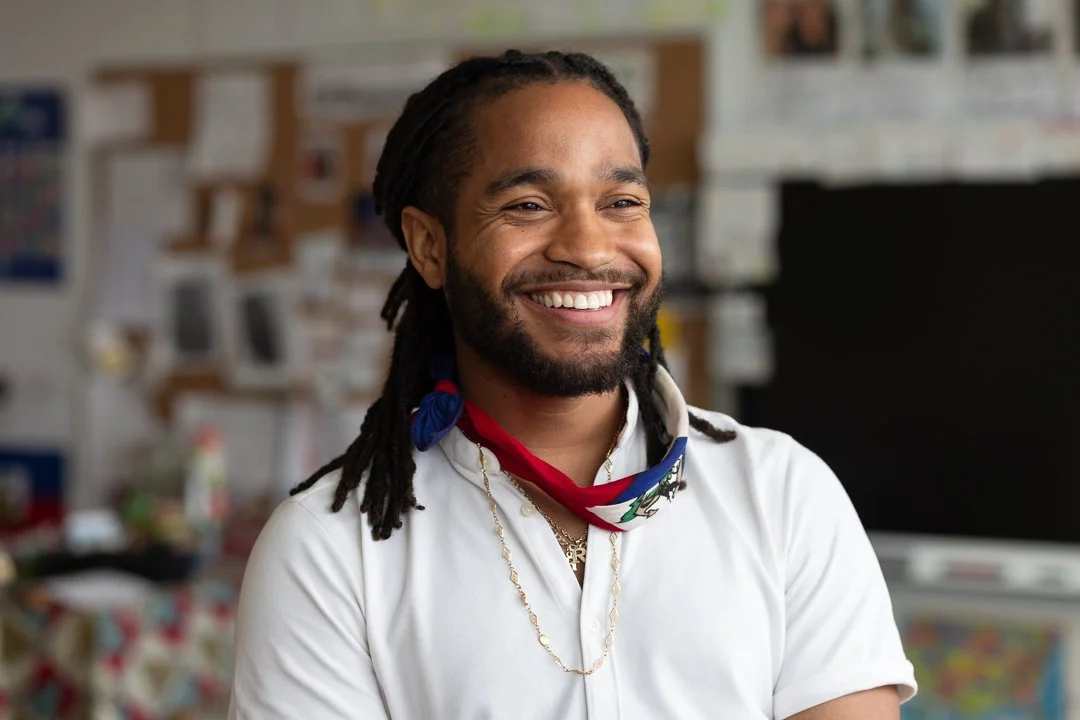
Raphael Bonhomme. Photo courtesy Teachers in Their Power.
DCAESJ Elementary Working Group co-facilitator Raphael Bonhomme shared a blog post on AFT’s Share My Lesson challenging teachers to move beyond seasonal lessons and to embed Black history into the full American narrative. Through personal reflection and practical classroom examples — from Harlem Renaissance projects to lessons on Black Wall Street — he invites educators to rethink what students learn about history, identity and possibility.
Bonhomme is a 3rd grade teacher at School Within a School, DCPS.
This year feels like one of those moments that asks us to pause.
Black History Month is celebrating its 100th anniversary, first established in 1926 by historian Carter G. Woodson. At the same time, the United States is inching closer to its 250th birthday, marking the signing of the Declaration of Independence in 1776. These milestones exist in different timelines, almost alternative universes, but they meet at the same moment — 2026.
Those dates matter. Not because of the numbers themselves, but because of what they force us to face.
They ask us to reflect on whose stories we have valued, whose stories we have centered, and what versions of America we continue to pass on to our students. If Black history is American history, are we teaching it that way?
How Black History Month Began — and Why It Still Matters
Black History Month did not begin as a celebration or a themed unit. It began as a correction.
Carter G. Woodson created Negro History Week because he recognized how thoroughly Black people had been excluded from the historical narratives taught in American schools. That exclusion was not accidental — it reflected whose lives were considered worthy of record and whose contributions were pushed to the margins. Learn more from The Man Behind Black History Month.
Woodson’s work was never about separating Black history from American history. His goal was to strengthen America’s understanding of itself by telling the full story. He believed that when students learn a more complete history, they develop a more honest relationship with their country.
A century later, that purpose still matters.
Yet in many schools, Black history is still treated as optional or seasonal. It shows up briefly in February, disconnected from the larger narrative. When that happens, students learn — whether we intend it or not — that Black history is something separate from “real” American history.
Growing Up Loving Learning — but Searching for Myself
I’ve been thinking a lot about this lately, partly because of my students and partly because of my own journey.
I grew up loving to learn. I genuinely enjoyed school. I liked reading, asking questions, and discovering new ideas. Learning felt exciting and meaningful to me.
But as a Black American student, I rarely saw myself reflected in the curriculum in ways that felt whole or affirming.
When Black people appeared in lessons, it was usually through a narrow lens — slavery, segregation, the Civil Rights Movement. Important history, yes, but often taught without continuity. Struggle without complexity. Pain without joy. Resistance without humanity. Over time, I felt disconnected and felt many of the topics were foreign. I became a case study of social proof and the similar-to-me effect without even knowing.
Outside school, the media didn’t offer much more. The stories I encountered shaped a limited view of what being Black in America meant. There were few examples of Black intellectuals, innovators, educators or leaders presented as central to the American story.
And when young people don’t see many possibilities modeled, it quietly shapes what they imagine is possible for themselves.