BLM at School A Lifetime of Practice
Centering Globalism and Loving Engagement at the BLM at School Curriculum Fair
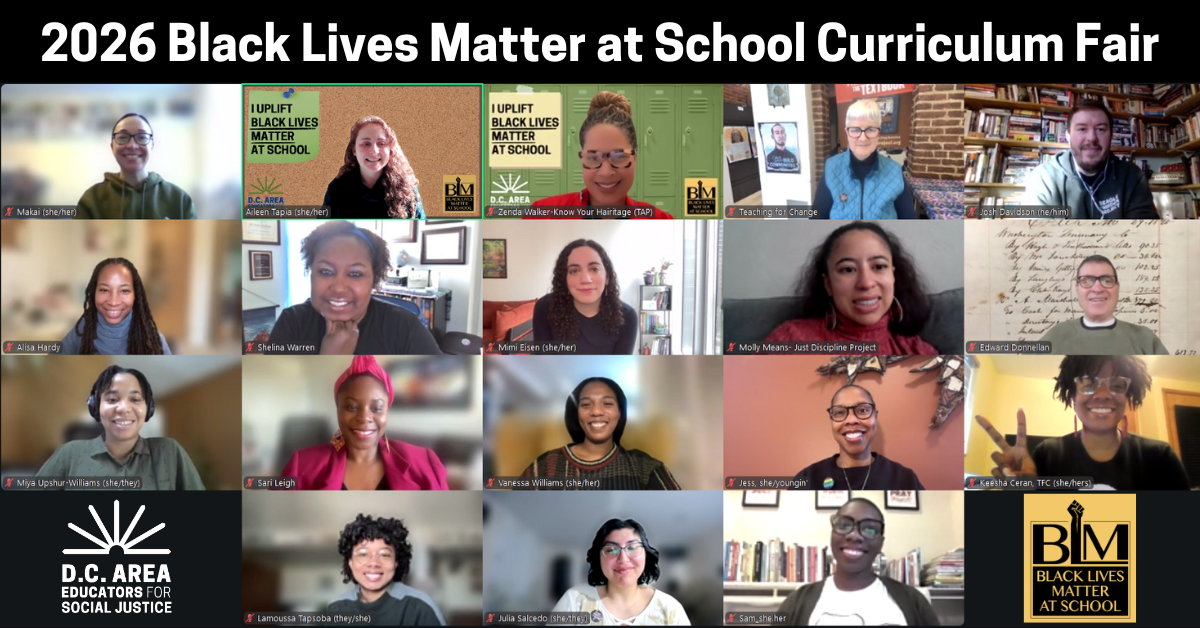
Event staff and presenters meet in preparation for the curriculum fair.
“…much debt is owed to the teachers and the truth tellers, to those who’ve pledged to study AND to struggle, to those dedicated to love, literacy and to liberation, to those oriented toward justice and joy, to students, to librarians, to archivists and activists, and of course to the Benevolent Ancestors past and present!” - Jessica A. Rucker, keynote speaker
On Saturday, January 24, 2026, Teaching for Change’s D.C. Area Educators for Social Justice hosted an online curriculum fair that uplifted the guiding principles and demands of the Black Lives Matter at School movement. With a powerful keynote from educator Jessica A. Rucker and interactive workshops, educators engaged in learning that centered Black joy, confronted anti-Blackness, and fostered authentic partnerships with all who work toward creating equitable school communities across the nation.
This year's featured guiding principles, Globalism and Loving Engagement, was fully embodied throughout the event. Educators from across the country and internationally gathered as part of a global family, sharing strategies, stories, and commitments to justice that transcended borders. Through collaborative discussions, participants practiced loving engagement by being active participants in conversations that sought to build communities grounded in love, interdependence, and collective care.
Participants left the event inspired and prepared for the 2026 National Black Lives Matter at School Week of Action (February 2–6, 2026) and Year of Purpose.
Participant quotes:
This just changed my world. I may not be the best at changing the world, but I'll do my best. Thank you for inspiring/teaching/leading me into new spaces with my students, as well as my own education. Much love from Kansas City!
I will plant seeds!!! These workshops have given me the ideas/inspiration for Black History Month, week of action and curriculum in my classes. I feel like a rock star today!!!
I will take the information I learned today and incorporate it into the Montessori curriculum in my primary classroom. I hope to continue to learn and grow within the Black Lives Matter at School curriculum, as I would like to continue to empower myself to serve my students better.
KEYNOTE
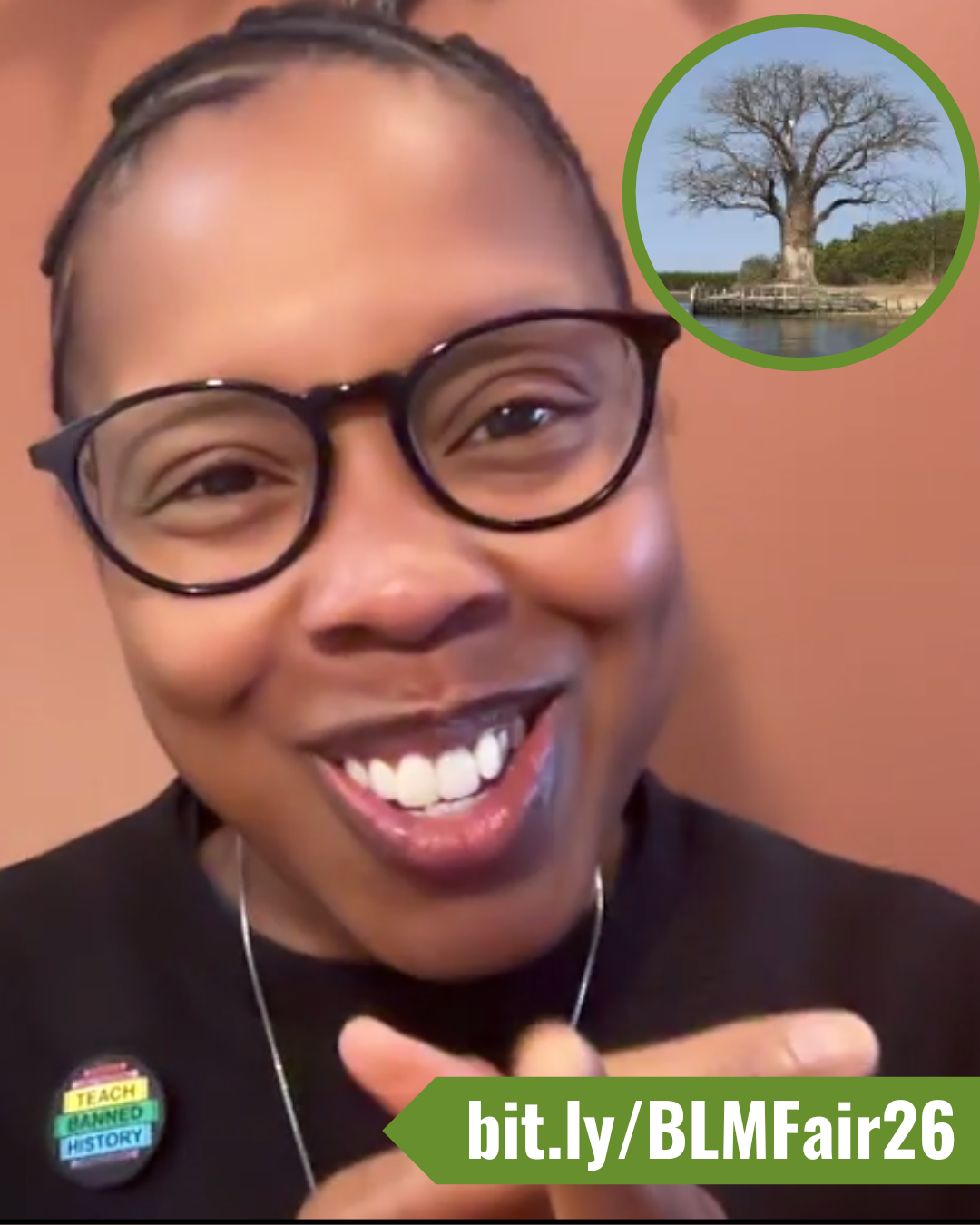
We were fired up 🔥from Jessica Rucker's keynote. She shared about a recent trip to Senegal, where she visited the 850 year old Sine-Saloum baobab tree. 🌳
“The Sine-Saloum baobab is OLD and WISE and embodies the principles of Globalism and Loving Engagement.
As educators and teachers dedicated to teaching the truth, we are like this baobab tree, while this current regime is like the sunny savanna and the fungus that attempts to wreak havoc!
Although they are wreaking havoc, because that’s what they do, the baobab endures, and helps everyone around them endure and thrive under some of the harshest conditions...
Remember, the lessons we learn and teach today, as well as the demands me make, will survive us for many todays and for many tomorrows AND will sustain our communities, across many continents, for many generations to come just like the baobab tree!”
-
Jessica A. Rucker (she/her) is a doctoral student in the Department of American Studies at the University of Maryland, College Park where she is studying Black radicalisms. Jessica is a President’s Fellow, a member of the Phi Kappa Phi Honor Society, a 2023-2025 graduate assistant at the Frederick Douglass Center for Leadership Through the Humanities, and a 2023-2024 DISCO Graduate Scholar. In 2023, she was a summer Tenant Organizing Fellow with DC Jobs with Justice and a 2022-2023 Prentiss Charney Fellow. Prior to Jessica’s graduate work, she was a high school social studies teacher, department chair, instructional coach, and a participant in the 2018 National Endowment for the Humanities Summer Teacher Institute at Duke University. She has also volunteered as a docent at both the National Museum of African American History and Culture and the National Museum of American History. Jessica resides in her home city, the U.S. colony of Washington, D.C., with her loving partner.
WORKSHOP TRACKS
This year we introduced workshop tracks to elevate our curriculum fair engagement. These tracks give more intentionality for building your Black Lives Matter at School lifetime of practice.
Click on the workshop title to read detailed descriptions, workshop highlights, and see resources for your classrooms and communities.
Black Lives Matter at School 101
Grounds participants in the nuts and bolts of Black Lives Matter at School guiding principles, week of action to a lifetime of practice.
Year of Purpose
Offered participants tangible classroom lessons and materials to design their week of action and year of purpose activities.
-
Archives in Class: Teaching with the Emergency Committee on the Transportation Crisis Records
Echoes of Activism: Crafting a Lesson Plan with Oral History from DC Public Library/DC Humanities
Hairitage as Social Justice: Identity, Power, and Liberation Through the Lens of Hair
Justice in Action: Equipping Students to Reimagine Democracy
Searching for Truth in the Garden; Gonzaga's History with Slavery
Teaching Public Memory Through the Breonna Taylor Mural Memorial Project
Lifetime of Practice
Supported participants self-learning to move beyond a year of purpose and into a lifetime of practice uplifting Black Lives Matter at School guiding principles and national demands.
WORKSHOPS
Archives in Class: Teaching with the Emergency Committee on the Transportation Crisis Records
SUBJECTS: History
GRADE LEVELS: High School
PRINCIPLES: Empathy, Loving Engagement, Diversity, Collective Value, Unapologetically Black, Black Women
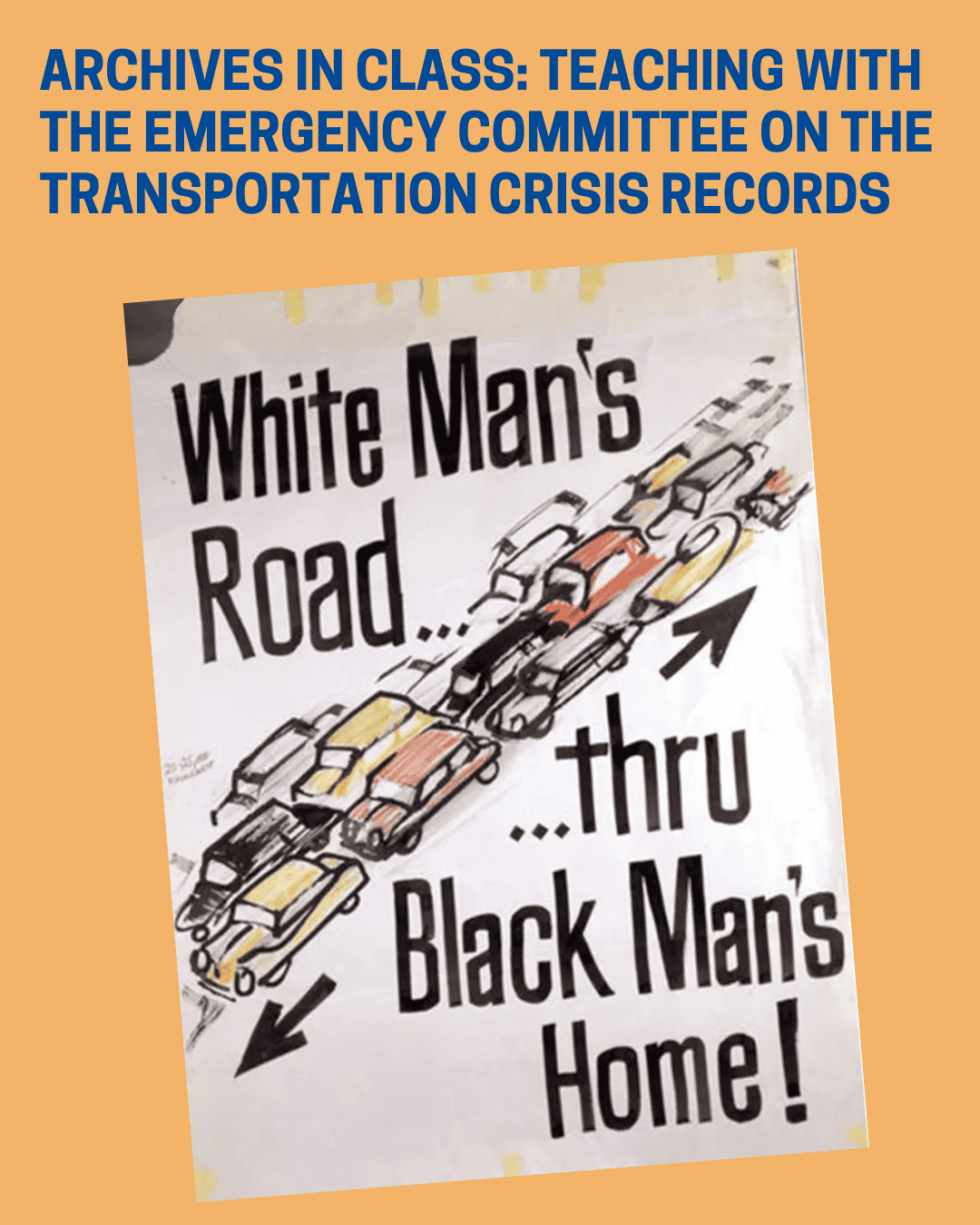
This workshop connected educators eager to enrich their teaching with unique, historical materials and engage their students on the topics of local history and social justice.
Educators explored how to bring local history and social justice into their classrooms through the use of archives and primary sources. Miya Upshur-Williams introduced participants to the resources and support available at The People’s Archive (housed at D.C.’s MLK Jr. Memorial Library), guiding them through a five-step process for creating their own primary source instruction kits. Teachers engaged directly with curated materials and activities about the Emergency Committee on the Transportation Crisis (ECTC), a grassroots coalition that, from the 1950s to the 1970s, successfully opposed a proposed urban expressway in Washington, D.C.
This prompted strong opposition from local residents galvanizing some to form the ECTC. For almost two decades, ECTC used lobbying, public protests, and demonstrations to halt freeway construction and protect neighborhoods. The organization advocated for a public Metrorail system as an alternative to freeway development and supported broader issues such as civil rights, environmental justice, and D.C. Home Rule and statehood.
Through hands-on exploration, participants discovered how ECTC’s advocacy for public transit, civil rights, environmental justice, and D.C. Home Rule can inspire meaningful classroom discussions. By the end of the session, participants felt more confident planning class visits to the archive and incorporating historical documents into their teaching to deepen student engagement with local history and activism.
-
Miya Upshur-Williams is an archivist, gardener, and dreamer based in her hometown of Washington, D.C. She possesses over 15 years of experience working in the library and archives fields. Her studies and life’s work center the culture, history, and liberation of Black people globally. She earned her Bachelor of Arts from Sarah Lawrence College and Master of Science in Information for Library and Information Science from Drexel University’s College of Computing and Informatics. At DC Public Library’s local history and Black Studies center, The People's Archive, Miya collaborates with educators to create meaningful experiences for students in the archives.
Beyond the Bell: Building Justice-Focused Thirdspaces in Schools
SUBJECTS: Other
GRADE LEVELS: Lower Elementary, Upper Elementary, Middle School, High School
PRINCIPLES: All
DEMANDS: End “zero tolerance” discipline and implement restorative justice
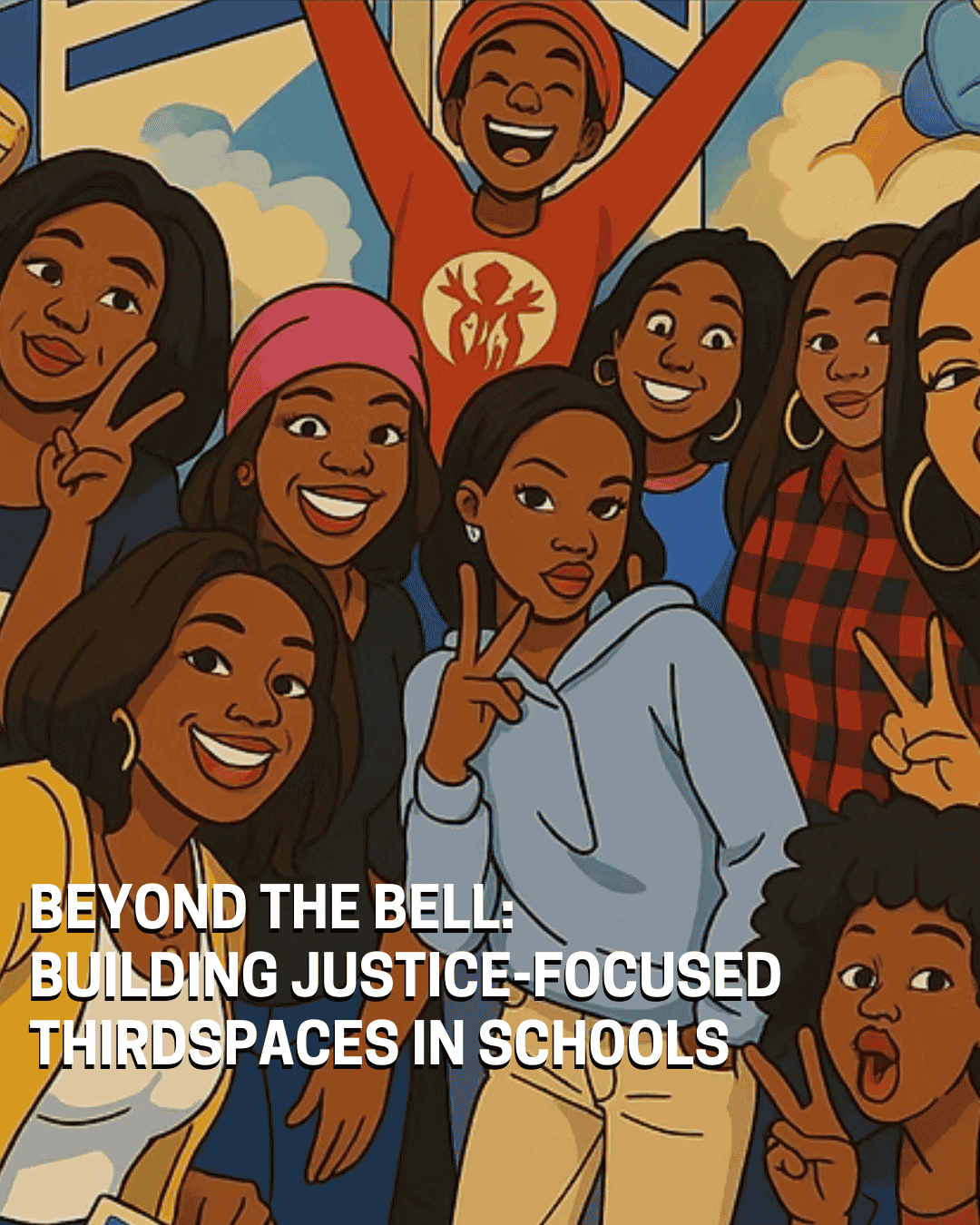
“How can extracurricular spaces become incubators for student activism and identity affirmation?”
This interactive workshop developed by Dr. Tia Dolet, explores how schools can create “thirdspaces” — liberatory environments where historically marginalized youth can build community, engage critical issues, and organize for justice — beyond the classroom. Grounded in research and praxis from the Thirdspace Collective, the session blends theory with hands-on design work.
Dr. Dolet started the session with an icebreaker in which participants introduced themselves and identified their own thirdspaces – a space (physical, digital, or emotional) where they felt most themselves, most free, or most creative. A space that lets them be messy, joyful, reflective, or bold. Participant response varied where some felt their homes and family spaces were their thirdspaces, while others shared that being in nature, near water, in gardens, in art rooms, or surrounded by music.
Dolet introduced the work of scholars Henri Lefebvre and Edward Soja and their working definition of Thirdspace Theory: Space is not neutral but socially produced. Perceived and conceived spaces blend to create a thirdspace where individuals can imagine, resist, and create new possibilities. It is a counterspace where marginalized people can resist dominant narratives, reclaim identity, and imagine new futures. Thirdspace is a tool for liberation.
Dr. Dolet outlined why thirdspaces are especially critical for Black students. She argued that thirdspaces should function as protective, affirming counterspaces for Black students, interrupting harm and allowing students to create, affirm, disrupt, support, restore, and enable dreaming and joy. Dr. Dolet also presented her research and a resulting three-component framework:
Disruption – How do we address inequities and injustice in our space?
Design – What intentional practices help build belonging, trust, and joy?
Dreaming – Are we leaving room for creativity, cultural expression, or collective visioning?
She noted how her research can be used to evaluate existing programs or as a design framework for establishing new ones. Several program scenarios were presented, in which participants were asked to examine the program features, design, and intended implementation, and decide whether the program might be a thirdspace for students and explain why or why not.
Dolet closed with a charge for attendees - How might you center joy, identity, or resistance in your programs moving forward?
Attendees left with strategies and inspiration to co-create liberatory third spaces that center student voice and community-building.
-
Dr. Tia Dolet is an intersectional education researcher, equity strategist, and founder of the Thirdspace Collective Consulting, LLC., an education consulting firm that partners with schools and non-profits to build justice-centered extracurricular programs rooted in cultural responsiveness and youth empowerment. With over a decade of experience advancing college access, workforce development, and educational justice, Dr. Dolet works at the intersection of research, strategy, and practice to transform how schools and organizations support historically marginalized youth.
Her research and praxis center on creating “thirdspaces” in education: Liberatory environments where Black and Brown students can develop critical consciousness, affirm their identities, and organize for change. She holds a Ph.D. in Curriculum and Instruction with a specialization in Urban Education from UNC Charlotte, where her work focused on gender-responsive programming and liberatory learning for Black girls.
Whether mentoring students, designing programs, or leading educator workshops, Dr. Dolet is driven by the mission to help young people thrive unapologetically in spaces designed with them in mind. She is also the proud aunt of two amazing nieces, who remind her every day why this work matters.
Black Lives Matter at School 101
SUBJECTS: Other
GRADE LEVELS: Early Childhood, Lower Elementary, Upper Elementary, Middle School, High School, Adult Education
PRINCIPLES: All
DEMANDS: All
This workshop reviewed the history, focus areas, and ways to be involved with Black Lives Matter(BLM) at School. It served as an introduction (or refresher) to educators engaging with BLM at School for the first time or looking for a refresher in foundations of BLM at School.
Led by BLM at School national organizer Sam Carwyn, the session provided a clear and grounding introduction to the movement and its application in school settings. Carwyn reviewed the origins of the February Week of Action and explained the significance of the four national demands, emphasizing that the work is about creating schools of belonging rather than checking a box. A key highlight was the framing of restorative justice as a practice not only for students but also for educators, inviting teachers to take accountability, acknowledge mistakes, and address conflict as part of a healthy school culture where students genuinely feel they belong.
Carwyn shared A Guide for Black Lives Matter at School and offered practical guidance for navigating pushback when implementing the curriculum. She addressed common objections, such as the belief that students are “too young,” countering that students are already experiencing race and racism without the language or context to understand it. The session included concrete examples of how educators can affirm and normalize Black lives in everyday classroom practices, from visuals and materials to curriculum choices and mentorship. Participants were invited to reflect on potential concerns they might face in their own schools, and Sam concluded by reviewing the daily themes of the Week of Action and strategies for engaging students across the guiding principles.
Participants were encouraged to subscribe to the Black Lives Matter at School YouTube channel and access the BLM at School Curriculum Guide via Are.na for more resources.
-
Sam Carwyn is a community-rooted educator and activist with more than two decades of experience in advocacy spaces. With Black Lives Matter at School, she develops resources, provides tools, and partners with educators and community members to advance racial justice for students. In the classroom, she primarily taught in Special Education, yet also holds an endorsement in middle school social studies. She holds an MA in Teaching and an MDiv with a concentration in Social Transformation.
Sam's work has centered on supporting youth and families, advancing reproductive justice, and educating alongside survivors of violence. With intentional grace, she helps others examine default thinking, navigate coercive systems, and cultivate self-determination. Deeply committed to accessibility and justice, she works to move us toward more equitable schools and communities.
Echoes of Activism: Crafting a Lesson Plan with Oral History from DC Public Library/DC Humanities
SUBJECTS: English Language Arts, Science, Arts Education, Other
GRADE LEVELS: Upper Elementary, Middle School, High School
PRINCIPLES: Empathy, Loving Engagement, Diversity, Trans Affirming, Black Families, Black Villages, Black Women
DEMAND: Mandate Black history and ethnic studies
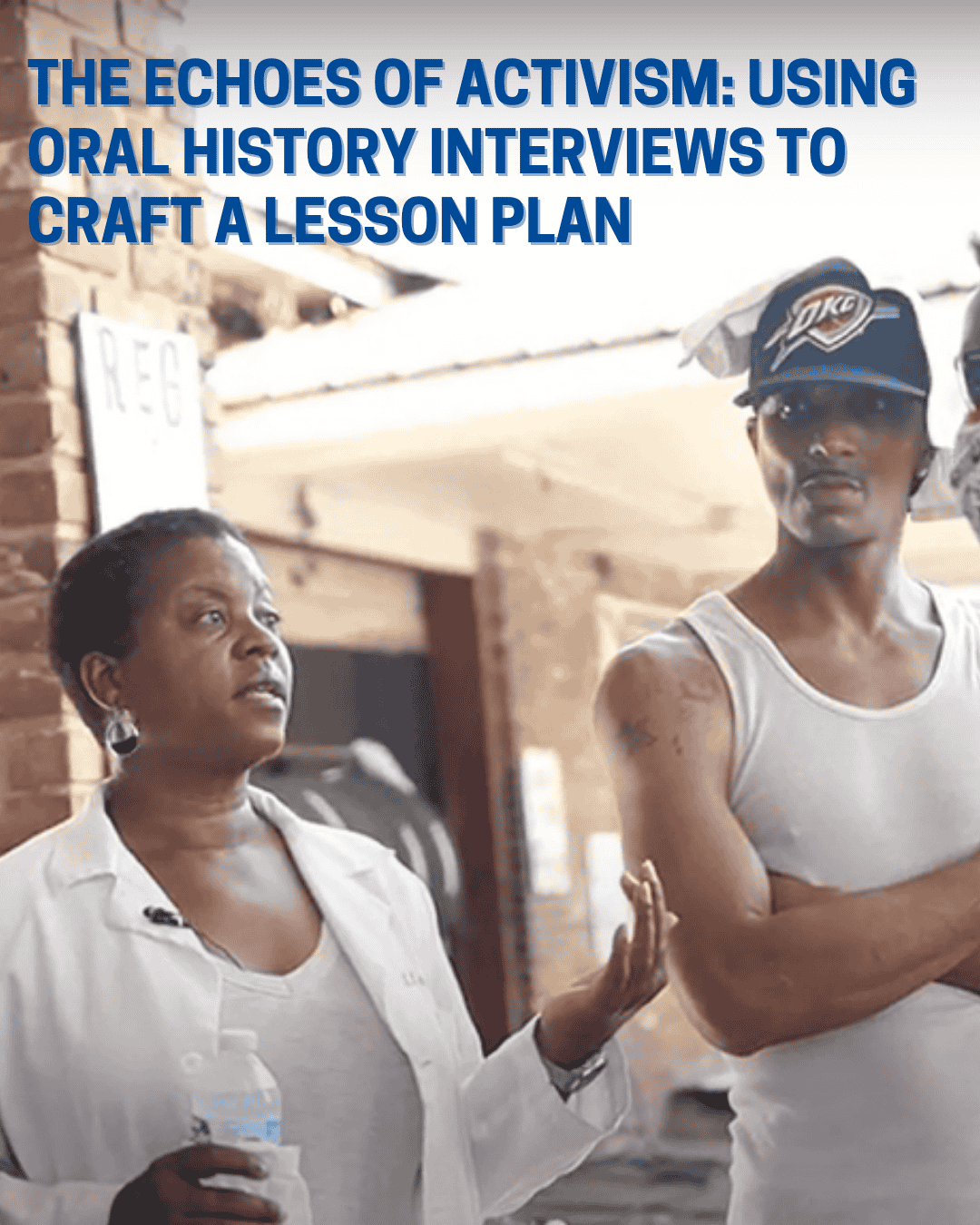
Presenter Sari Leigh introduced educators to oral history as a powerful tool for social justice education. During the interactive session, participants engaged with excerpts from the Mind, Body, and Justice Oral History Project, as well as other Washington, D.C. based archives. Through deep listening activities, educators examined themes of community care, resilience, and activism embedded within the narratives. The session encouraged participants to slow down and carefully consider the voices and lived experiences shared in these oral histories, highlighting how personal storytelling can deepen historical understanding.
Throughout the workshop, educators explored how oral histories could be incorporated into meaningful, student-centered lessons that elevate local voices and perspectives. Through discussion and reflection, participants considered ways to translate the narratives they heard into culturally responsive lesson plans that connect students to their communities. The session emphasized how oral history can help students understand history through a social justice lens while empowering them to engage with the experiences and wisdom of local residents.
-
Sari Leigh, aka the Anacostia Yogi, is a health advocate, education administrator and digital media activist living east of the Anacostia River in Washington, D.C. Sari Leigh teaches wellness classes and germinates creative projects that advocate for equitable health and wellness access for residents east of the Anacostia River. Sari recently completed the Mind, Body and Justice Project and the DC Superhero documentary about wellness and activism in Washington, D.C.
Grow in Solidarity: Start Your Own Study Group
SUBJECTS: Other
GRADE LEVELS: ALL
PRINCIPLES: Empathy, Diversity, Collective Value, Black Families, Unapologetically Black
DEMAND: End “zero tolerance” discipline and implement restorative justice, hire and retain Black teachers, mandate Black history and ethnic studies, fund counselors not cops
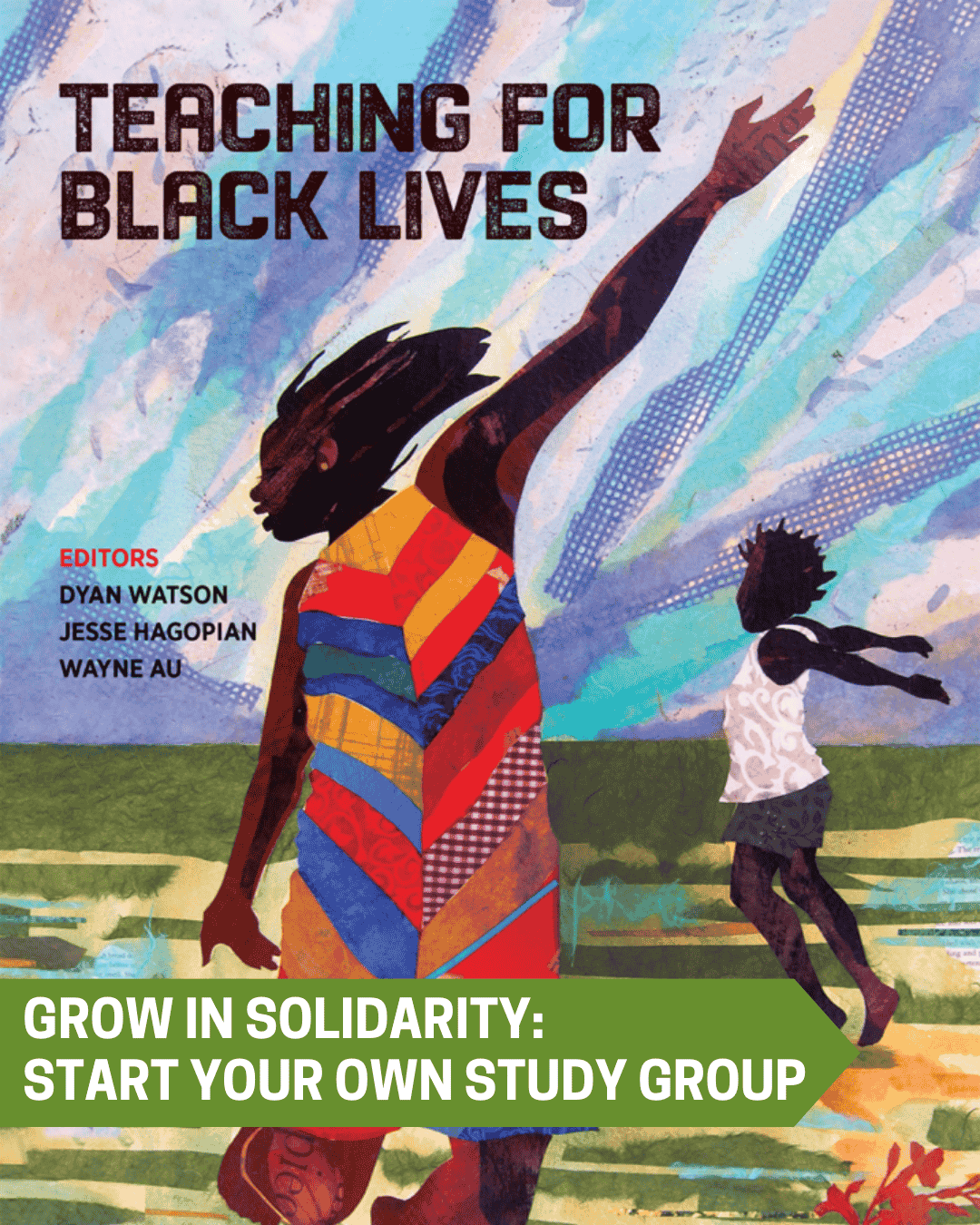
Grow in Solidarity was designed for educators seeking to deepen their practice through collaborative, justice-centered professional learning communities. Educators explored the power of study groups as transformative spaces for professional growth and collective action.
Julia Salcedo, Zinn Education Project staff member and manager of the Teaching for Black Lives study groups, guided participants through the history, benefits, and logistics of starting their own study groups through the Zinn Education Project. Participants got to hear from teachers coordinating study groups: Dr. Kushya Sugarman (4th-grade teacher, recent PhD graduate, and study group coordinator in New York City) and Lindsay Paiva (3rd-grade ESL teacher and study group coordinator from Providence, Rhode Island).
Kushya reflected on how study groups and access to Rethinking Schools sustained her through moments of setback, including navigating administrative pushback after collaborating on an anti-ICE project with third graders. She emphasized that "this work is non-linear. It advances, retreats, and re-emerges." In small groups, participants discussed questions and brainstormed ideas about hosting and participating in study groups. Through a closing Q&A, session coordinators and Zinn Education Project staff answered questions for participants.
-
Jesse Hagopian, a high school educator for over twenty years, editor for the social justice periodical Rethinking Schools, author of Teach Truth, and co-editor of the books Black Lives Matter at School and Teaching for Black Lives.
Julia Salcedo provides administrative support to educators coordinating the Teaching for Black Lives study group nationwide and highlights creative teachings stories of how participants celebrate Black Lives Matter at School Week of Action year after year.
Hairitage as Social Justice: Identity, Power, and Liberation Through the Lens of Hair
SUBJECTS: History
GRADE LEVELS: Upper Elementary, Middle School, High School
PRINCIPLES: Restorative Justice and Transformative Justice, Empathy, Loving Engagement, Diversity, Globalism, Black Families, Unapologetically Black, Black Women
DEMAND: Mandate Black history and ethnic studies
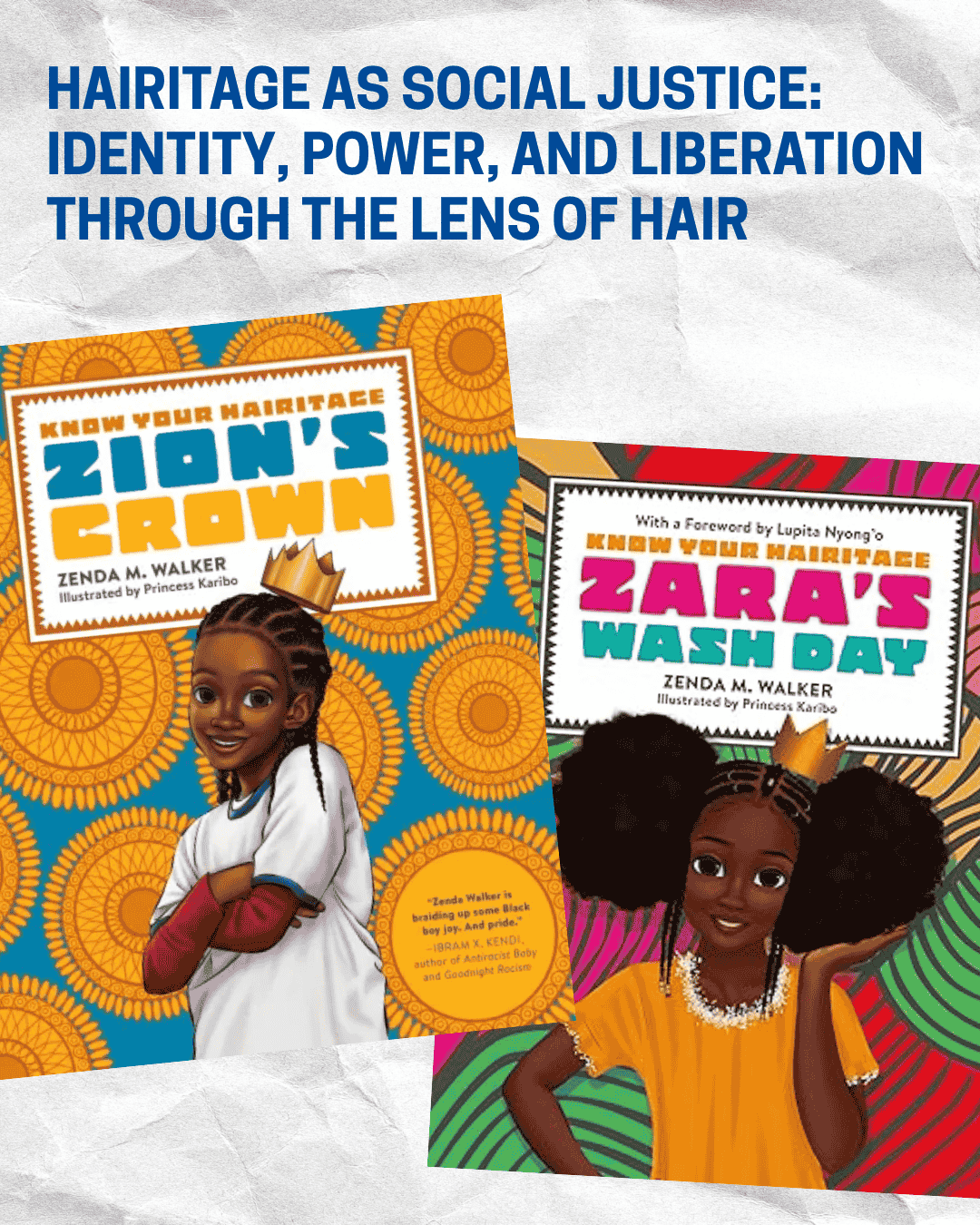
The workshop explored the idea that while hair is universal, the politics surrounding it are not. Using Hairitage as a social justice lens, the session invited educators to reflect on identity with curiosity and empathy while challenging biased narratives about hair. Zenda Walker opened the session by inviting participants to share personal experiences with hair and hair care in the chat, including reflections on how they viewed curly and coily hair growing up. This activity grounded the discussion in personal identity and highlighted how early messages about hair shape perceptions of beauty, professionalism, and belonging. A powerful moment in the workshop came through the Crowned Ladies video, which illustrated how hairstyles such as braids historically carried deeper cultural meaning. Participants learned that enslaved people sometimes used braided hairstyles to hide food or support survival during resistance and forced relocations during the transatlantic slave trade. The video’s message, “If our hair could talk, it would speak to the survival of a people,” reinforced the role of hair as a symbol of resilience, identity, and cultural survival within Black communities.
The session also examined how hair continues to be policed in modern educational spaces. Through case studies of Andrew Johnson (2018), Deandre Arnold (2020), and Darryle George (2023–2024), participants explored how school policies have been used to discipline or exclude Black students because of their hairstyles. A virtual gallery walk featuring images from Madagascar and the Fulani and Zulu communities in South Africa further deepened the conversation about how hair intersects with race, gender, colonization, and forced assimilation. The session concluded with discussion of the Crown Act, which prohibits race-based hair discrimination, and encouraged educators to reflect on the messages they received about hair growing up and how those messages influence their practice. Overall, the workshop emphasized that hair is an identity marker rather than a behavior, and that culturally responsive teaching begins with dignity, awareness, and policies that support belonging.
-
Zenda Walker is an award-winning author, celebrity hair stylist and education consultant. Her consulting business, Know Your Hairitage LLC., partners with school districts to amplify Social Studies, ELA, S.T.E.A.M. and vocational learning by amplifying hairitage stories. Her books Zara's Wash Day and Zion's Crown, launched in partnership with Running Press Kids in 2024. Zenda is represented by The Seymour Agency. For more information, visit www.knowyourhairitage.com.
Justice in Action: Equipping Students to Reimagine Democracy
SUBJECTS: History
GRADE LEVELS: High School
PRINCIPLES: Empathy, Collective Value
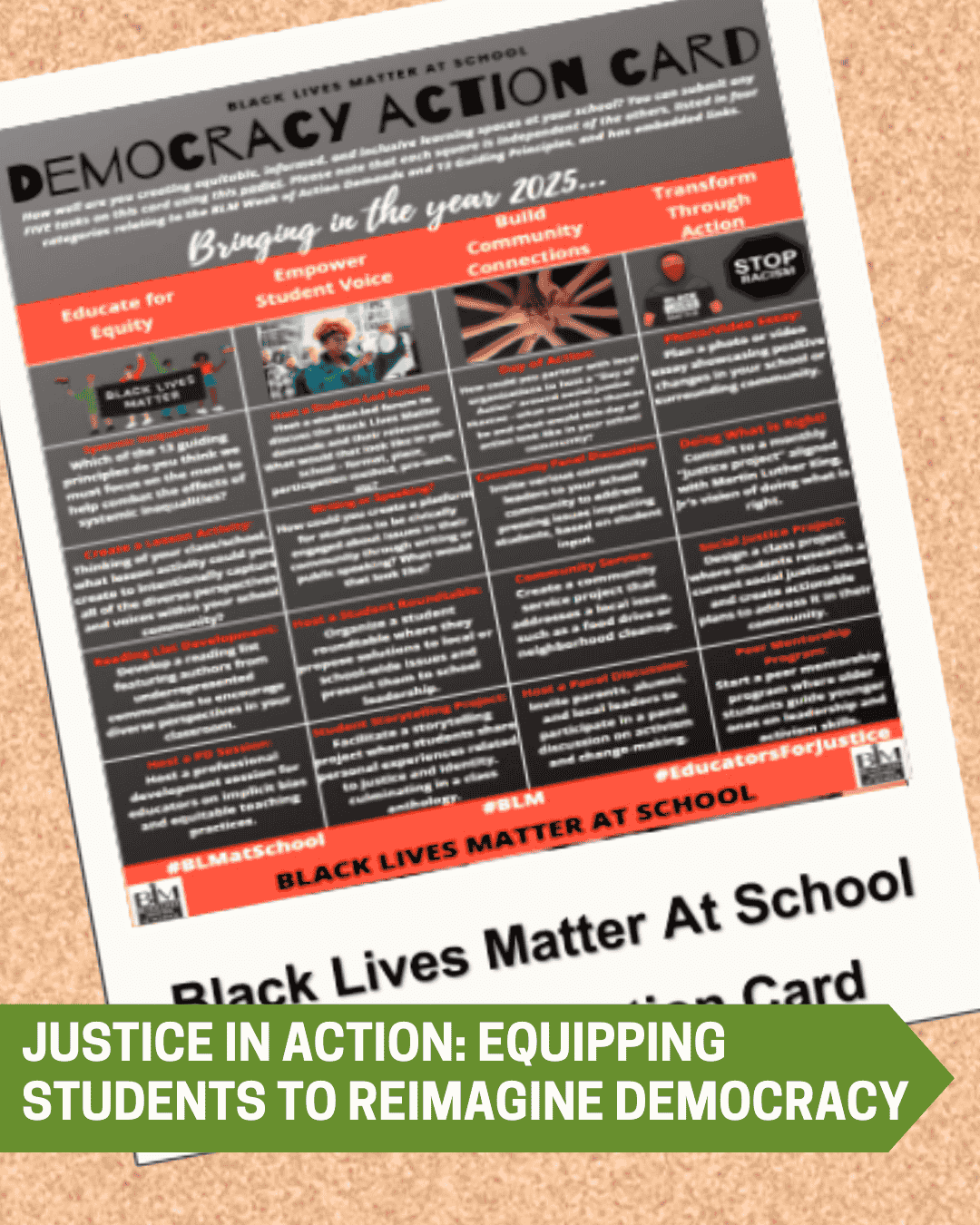
In this workshop, facilitated by Army veteran and social studies teacher Dr. Shelina Warren, educators explored strategies for empowering students to become active participants in democracy and social justice. The session introduced the Democracy Action Card as a tool to spark critical inquiry and help connect classroom learning to real world civic engagement. Through guided discussion, participants reflected on the importance of centering student voice and lived experience when designing lessons that encourage young people to question systems of injustice and imagine more equitable futures.
Throughout the workshop, educators engaged in hands-on activities that demonstrated how the Democracy Action Card could be used to support anti-racist, justice-focused civic learning in the classroom. Participants collaborated with one another to think about how these strategies could be incorporated into their own teaching practices and classroom projects. By the end of the session, educators left with practical tools and renewed inspiration to support students as informed participants in democracy and as agents of change within their communities.
-
Dr. Shelina Warren is an Army veteran and social studies educator with 22 years of experience. Currently in her tenth year at Dunbar High School in Washington, D.C., she teaches Constitutional Law, Law & Justice Advocacy, Youth Justice, and Human Rights and Social Action. Dr. Warren is also the director of the Eleanor Holmes Norton Law and Public Policy Academy, fostering student voices for change. She holds multiple degrees, including a Doctorate in Urban Leadership from Johns Hopkins University. Dr. Warren is a National Board Certified teacher, with numerous awards such as the 2022 American Civic Education Teacher Award and the 2021 DC Teacher of the Year Finalist. Before moving to DC, she taught high school Civics, Economics, and gifted K-6 students in Arkansas.
Lessons from SNCC for Organizing Today
SUBJECTS: History
GRADE LEVELS: Upper Elementary, Middle School, High School, Adult Education
PRINCIPLES: Diversity, Collective Value, Intergenerational, Black Families, Unapologetically Black, Black Women
DEMANDS: Mandate Black history and ethnic studies
Most people think about the Civil Rights Movement in terms of major public events, like the March on Washington and Dr. King's campaigns in Birmingham and Selma. They know much less about SNCC's longer-term organizing tradition and bottom-up approach to voting rights and education in the rural deep South from 1961 to 1966. SNCC's grassroots organizing with local people focused on skills and leadership development that helps us rethink the work involved in the Civil Rights Movement. This workshop highlighted SNCC's use of Freedom Teaching as part of their organizing work, which was incorporated informally in their daily work and more formally through Citizenship Classes and Freedom Schools aimed at young people.
Led by SNCC veteran Judy Richardson and history professor Emilye Crosby, the interactive, hands-on session used a newly developed Freedom Teaching toolkit and the SNCC Digital Gateway website (SNCCdigital.org) to engage participants in exercises that highlighted grassroots organizing and community-based activism. The session started with a brief "SNCC in 4 Minutes" overview, where educators learned to navigate the SNCC Digital Gateway. The website features profiles of key organizers, timelines of events, and archival material curated by SNCC veterans.
Utilizing experiential learning practices, participants gathered in small groups and analyzed photographs to illustrate SNCC's approach to Freedom Schools, explored profiles of key people and events on the SNCC Digital Gateway, and examined documents that SNCC used to teach those with low literacy about political candidates and elected positions. Judy Richardson also shared stories that brought SNCC's Freedom Teaching to life.
By the end of the workshop, participants gained concrete tools for teaching SNCC's history "from the inside out and bottom-up" and left with access to the Freedom Teaching toolkit and SNCC Digital Gateway resources to actively engage with SNCC's principles of organizing and civic leadership in their own classrooms.
-
Judy Richardson was on SNCC staff in Georgia, Mississippi, and Alabama. Her experiences in SNCC continue to ground both her film and education work. She recently co-directed the new visitor center film for the National Park Service’s Frederick Douglass House in Washington, D.C. In 1968, she was a co-founder of Drum & Spear Bookstore, once the country’s largest African American Bookstore. She was on the production team for all 14 hours of the seminal PBS series, Eyes on the Prize, as its series associate producer, then its education director, and then continued to produce documentaries for PBS, the History Channel, and museums. She co-edited Hands on the Freedom Plow: Personal Accounts by Women in SNCC, a compilation of the testimonies of 52 SNCC women. She is a member of the SNCC Legacy Project board, was a Visiting Professor at Brown University, and has an honorary doctorate from Swarthmore College.
Emilye Crosby is the author of A Little Taste of Freedom: The Black Freedom Struggle in Claiborne County, Mississippi (University of North Carolina Press, 2005) and editor of Civil Rights History from the Ground Up (University of Georgia Press, 2011). She is working on several projects related to SNCC (Student Nonviolent Coordinating Committee), which have received support from the James Weldon Johnson Institute, the National Humanities Center, and the National Endowment for the Humanities. Crosby has been awarded the Chancellor’s Award for Teaching, the Chancellor’s Award for Service, the Harter Mentoring Award, the Spencer Roemer Supported Professorship, and the President’s Award for Scholarship. Her first book was awarded the Liberty Legacy Foundation Award, Honorable Mention from the Organization of American Historians and the McLemore Prize from the Mississippi Historical Society. Her interest in the Civil Rights Movement grew out of her childhood in Mississippi and she especially enjoys working with the SNCC Legacy Project and Movement History Initiative.
Rooted Teachers, Thriving Students: Strengthening Ourselves First to Grow Racial Pride, Belonging, and Justice in Our Classrooms
SUBJECTS: Other
GRADE LEVELS: Adult Education
PRINCIPLES: Restorative Justice and Transformative Justice, Empathy, Loving Engagement, Diversity, Collective Value, Intergenerational, Unapologetically Black, Black Women
DEMANDS: End “zero tolerance” discipline and implement restorative justice, mandate Black history and ethnic studies, fund counselors not cops
Rooted Teachers, Thriving Students was designed for educators seeking to deepen their own racial consciousness as a foundation for creating more equitable and liberatory classrooms.
Educators explored an essential question: How do we expect students to thrive in their racial identities and be champions of racial justice when the adults guiding them may not have done the same work?
Molly Means, Lead Restorative Practice Coordinator for the Just Discipline Project (JDP) and facilitator and workshop developer for the Racial Equity Consciousness Institute, guided participants through an interactive session examining how educators' identities, biases, and positionalities shape how they show up in the classroom and the impact this has on the students they serve.
Using an intersectionality graphic, Means invited participants to explore why identities are represented as overlapping, highlighting that identities are complex and interconnected, and that they shape our lived experiences and perspectives. The session also examined how identity can influence bias. Means connected this learning to classroom practice by discussing the importance of naming racism and engaging students in conversations about identity.
Through guided reflection and critical dialogue, participants examined the messages that shape their own social identities and those of others. The session concluded with an identity reflection activity that provided concrete strategies to help them build liberated classroom communities where everyone, especially Black youth, experiences belonging.
-
Molly Means serves the University of Pittsburgh’s Center on Race and Social Problems (CRSP) as both the Lead Restorative Practice Coordinator for the Just Discipline Project (JDP) and a facilitator and workshop developer for the Racial Equity Consciousness Institute (RECI).
As JDP’s Lead Restorative Practices Coordinator, Molly works at the intersection of racial equity, conflict resolution, and school-based restorative practices. She designs and delivers teacher-informed professional development, coaches restorative staff across multiple schools, and leads internal racial equity consciousness learning for the JDP team. Molly proudly serves the Duquesne City School District, implementing restorative justice programming, teaching SEL, conflict resolution, social justice, leadership and Black history.
Molly is the creator of Breaking Racial Inequities with Dialogue and Guidance for Educators (BRIDGE), a racial equity program that supports K–8 educators in developing the racial consciousness, racial pride, and justice-centered pedagogies needed to build liberatory classrooms.
In addition to her work with JDP, Molly facilitates and develops workshops for CRSP’s Racial Equity Consciousness Institute (RECI), creating responsive and accessible programming to help participants grow their racial equity consciousness.
She also serves as a Middle School Programming Specialist for Parenting While Black, supporting racial identity development and coping skills for Black youth.
Molly's work centers the belief that both young people and educators can transform conflict into opportunity, connection and collective liberation.
Searching for Truth in the Garden; Gonzaga's History with Slavery
SUBJECTS: History
GRADE LEVELS: Middle School, High School, Adult Education
PRINCIPLES: Restorative Justice and Transformative Justice, Empathy, Loving Engagement, Diversity, Collective Value, Intergenerational, Black Families, Black Villages, Unapologetically Black, Black Women
DEMANDS: End “zero tolerance” discipline and implement restorative justice, mandate Black history and ethnic studies
The session highlighted the extraordinary work of a group of high school students who uncovered their school’s historical ties to slavery. Over the course of three years, the students spent countless hours researching in the Georgetown University archives, carefully examining 19th-century ledgers and historical documents. Through their investigation, they discovered direct financial evidence showing that profits from Jesuit slave plantations were used to help pay for the land on which their school was built. Perhaps most significantly, the students were able to identify five enslaved individuals who had worked at the school. Their research focused particularly on one of those individuals, Gabriel Dorsey. Using archival records, the students traced evidence showing that Gabriel had been enslaved at their school, later transferred to Georgetown College, and eventually sold to slave traders who transported him to New Orleans. The presentation shared several of the original historical documents that the students uncovered, bringing the story to life through primary sources.
Participants then turned to the question of how a school community grapples with newly uncovered and difficult histories. Ed Dollen shared student poetry that had been written in response to the research, demonstrating how students processed the emotional and historical weight of their discoveries. Recounting an annual field trip to the Freedom House Museum in Alexandria, Virginia, the site where Gabriel Dorsey was held after being sold by the Jesuits in 1829, Dollen shared that students retraced Gabriel’s final documented steps, from the slave pen to the Potomac River waterfront, where he was placed on a ship and sold in New Orleans. This experience allowed students to connect historical research with place-based learning and reflection, deepening their understanding of the human stories behind the historical records.
-
Ed Donnellan is a United States history teacher at Gonzaga College High School in Washington, D.C. He worked with a group of students beginning in 2018 that uncovered Gonzaga's historical ties with slavery. The student research has been displayed at Ford's Theater in Washington D.C., Georgetown University, and the Freedom House Museum in Alexandria, VA. Ed was the recipient of the 2020 Gilder Lehrman DC History teacher of the year, as well as the 2025 Mary Tachau Award given by the Organization of American Historians in recognition of the contributions made by precollegiate teachers to improve history education within the field of American history.
Taking Action for D.C.’s Black Students: Changemakers Exemplify the BLM at School Guiding Principles and Demands
SUBJECTS: History
GRADE LEVELS: Middle School, High School, Adult Education
PRINCIPLES: Black Villages, Unapologetically Black, Black Women
DEMANDS: Hire and retain Black teachers, mandate Black history and ethnic studies, fund counselors not cops
This workshop invited participants to take a close look at three pivotal moments in Black education history in Washington, D.C., as highlighted in the DC History Center’s long-term exhibit Class Action: Education and Opportunity in the Nation’s Capital. Vanessa Williams shared stories of key changemakers Nannie Helen Burroughs, Julius Hobson, and the advocacy group Parents United for the DC Public Schools. Williams explored how community leaders and activists challenged inequities in education. She then guided participants through how these figures exemplified many of the guiding principles and national demands of the Black Lives Matter at School movement, particularly by confronting misogynoir in teacher education programs, dismantling segregation through curriculum tracking practices, and organizing against inequities in school funding and resources.
During the session, participants analyzed a number of primary and secondary sources connected to each historical episode, allowing them to engage directly with the evidence and stories behind these movements for educational justice. Small group discussions provided space for educators to reflect on the material and consider how these histories could be incorporated into their own curriculum and teaching practices. The workshop concluded with participants receiving free digital resources connected to the exhibit, enabling them to continue exploring these histories to bring them into their classrooms.
-
Vanessa Williams is the manager of education at the D.C. History Center, and previously served as the program manager for D.C. Area Educators for Social Justice. Vanessa holds a masters in Education, Culture, and Society from the University of Pennsylvania Graduate School of Education, as well as a BA in Anthropology and Education from Davidson College. She has been featured on panels for the Mid-Atlantic Equity Consortium. She’s also been a guest on the EmpowerEd Educator Wellness Revolution and Anti-Racist table podcasts. Her writing is published in Washington History magazine, Rethinking Schools and Education Post. She was raised in Jacksonville, Florida, and points to trailblazers like Mary McCleod Bethune, Anna Julia Cooper, and Zora Neale Hurston for shaping her combined love for public history and K-12 education and serving as pedagogical inspiration.
Azia Richardson-Williams is the Education Coordinator at the D.C. History Center, where she develops curriculum that helps educators and students explore Washington, D.C.’s history through inquiry-based learning. She also helps steward National History Day in D.C., collaborating with teachers, judges, volunteers, and community partners to support students as they research, write, and present original history projects. Azia is also pursuing dual master’s degrees at George Washington University, a Master of Public Administration and an MA in Museum Studies, bringing a program evaluation lens to cultural and education work. Her work centers on civic learning, equity, and helping communities see themselves reflected in history.
Teaching Public Memory Through the Breonna Taylor Mural Memorial Project
SUBJECTS: History, Arts Education
GRADE LEVELS: Middle School, High School, Adult Education
PRINCIPLES: Empathy, Loving Engagement, Black Villages, Black Women
DEMANDS: Mandate Black history and ethnic studies
In this workshop, Dr. Alisa Hardy introduced attendees to the Breonna Taylor Mural Memorial Project (BTMMP), an interactive ArcGIS StoryMap that documents murals honoring Breonna Taylor across the United States.
The StoryMap presents public art as a form of remembrance and community storytelling by linking murals to the neighborhoods where they appear. This digital humanities project was developed by Dr. Hardy as part of her field research on murals portraying Taylor and other victims of police violence within marginalized neighborhoods. During her fieldwork, Dr. Hardy visited each mural site in person, photographed and filmed the surrounding spaces, and captured drone and 360° images.
Dr. Hardy guided Participants through the BTMMP. Collectively, they discussed the implications of StoryMaps that honor Black lives and explored classroom activities that educators can use alongside the project. Educators learned how to use the BTMMP to help students examine public memory, social justice, and the role of art in civic life.
Dr. Hardy encouraged participants throughout the workshop to think about their own communities: Are there any murals, memorials, monuments, statues, museums, or plaques that stand out? What stories are they trying to tell about the past, the people, or the place?
-
Alisa Hardy is an Assistant Professor in the Department of Communication at the University of Illinois Urbana-Champaign. Her research focuses on the public memory of Black women, especially how communities remember women who have been killed by police. Drawing on examples from the #SayHerName movement, her work examines how digital media, public art, and community memorials are used to honor Black women’s lives and tell their stories. Hardy’s scholarship helps educators think about how memory, history, and technology shape the ways students encounter social justice issues both online and in public spaces.