
Stories From 2018 Black Lives Matter Week of Action
Here are stories from each day of the 2018 DC Area Black Lives Matter at School Week of Action.

On December 19, 2018, D.C. Area Educators for Social Justice hosted an Educator Open House at the Teaching for Change office for Black Lives Matter Week of Action in Schools. Read more >>

On November 13, educators from across the D.C. area gathered for the first planning meeting for the upcoming 2019 Black Lives Matter at School week of action happening, February 4-8, 2019. Read more >>

The lead coordinating organizations for the D.C. Black Lives Matter Week of Action in Schools are Teaching for Change and the Center for Inspired Teaching. They were joined by people from many other organizations and schools.

I used a number of lessons from D.C. Area Black LIves Matter Week of Action resource page and others I collected at that BLM curriculum share. #Lastwords was one of the most powerful lessons for many of my students.I have a number of students with significant learning disabilities as well. So in their classes, I used the lesson related to the book Milo's Museum. We're still working on this unit, but they seem to really be enjoying it!

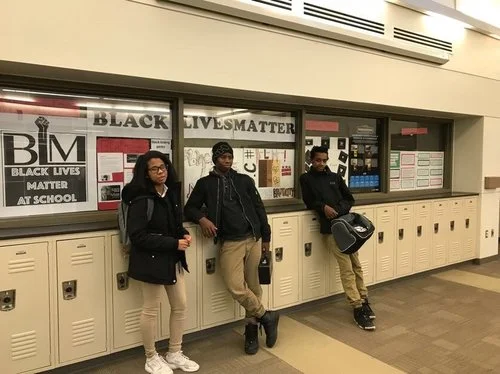
The D.C. Area Black Lives Matter Week of Action in Schools gave a powerful start to Black History Month in classrooms across the Washington, D.C. area. Pre-K — 12th grade teachers in more than 100 schools taught lessons about structural racism, intersectional Black identities, and Black history.

Makia Green, a member of Black Lives Matter DC chapter, visited my kindergarten classroom, provided a presentation to students and read Child of the Civil Rights Movement.

Now that February is ending (how is it already March?!), we are looking back to the beginning of the month when we participated in the nationwide Black Lives Matter at School Week of Action. When talking about something like Black Lives Matter with third graders, we work hard to make sure that the points of entry and examples are tangible, accessible, and developmentally appropriate.

At School Without Walls at Francis Stevens (DCPS), students in my elementary ESOL class read a newsela article and watched a Ted Talk in order to understand the term "systemic racism" and how it impacts people in the United States and in other countries.

In my fifth grade classroom at Rockview Elementary School (MCPS), we spent the majority of the reading block during the Black Lives Matter Week of Action in Schools reading and analyzing poems by Langston Hughes.

Inspired Teaching Fellow Jay Banks’ 2nd-grade classroom at DC Scholars PCS focused on Black Lives Matter by discussing resistance and advocacy. The class read Crossing Bok Chitto by Tim Tingle, the fictional story of the friendship between a young Choctaw girl and an enslaved African boy.

As a part of Black Lives Matter Week of Action in Schools, SEED Public Charter School educator Topher Kandik did a powerful lesson on the last words of victims of police brutality.

Washington Yu Ying's 5th graders held discussion lessons each day of the week, connecting what they know about social justice with the Black Lives Matter Movement. Today, the entire school participated in a Black Lives Matter/Black History Month read aloud.

An Inspired Teaching Demonstration School educator wrote… "In a school where Black Lives Matter, we embrace uncomfortable, messy, and yet essential conversations about race. We recognize the systemic injustice of our society and we work daily to provide a school environment that is safe, inclusive, and affirming for every student, without exception." While a Student at the Inspired Teaching Demonstration School wrote...

Kindergarten students in Sandhya Rajan's class are solidifying their commitment to valuing and protecting Black lives by adding their signature to the "BLACK LIVES MATTER" banner at LaSalle-Backus Education Campus.

As part of the Black Lives Matter Week of Action in Schools, U.S. government teacher Ben Williams from Capital City Public Charter School taught a lesson titled “Getting to Know Bayard Rustin: A key leader and organizer of the Civil Rights Movement.”

Inspired Teaching brought together students and adults from across the D.C. area to engage in intergenerational dialogue about Black Lives Matter. To kick-off the evening, Makia Green, a representative from the Black Lives Matter DMV chapter inspired the audience with her compelling story of how she began organizing for #BlackLivesMatter at a young age.

Inspired by the Black Lives Matter Movement, the Teen Writers of The Beacon House, a community-based organization in Northeast Washington, D.C. wrote The Day Tajon Got Shot. The book tells the story of a teen killed in a police shooting from multiple perspectives, challenging the reader to gain knowledge from the whole picture. The young authors presented at Mt. Pleasant Library.

High school U.S. history students attended a presentation by SNCC veteran Courtland Cox, coordinated by teacher Lordsline Exantus. Cox explained to the students that his years of activism began when he was their age, and like many of them, he grew up in an immigrant household. He also told them that the in the 1960s, the apartments near their school were for whites only and that he protested the DC football team for not allowing Black players.

Educator Trisha Boyd, at KIPP DC Lead Academy, conducted a read aloud on accepting differences to the entire second grade.

This week, HB Woodlawn Program (Arlington Public School) educator, Christy Gill, had her 8th grade students explore the meaning of justice.

For the DC Black Lives Matter Week of Action in Schools, Inspired Teaching Fellow Brittney Henderson (‘13) and her kindergarten students at West Education Campus (DCPS) read One by Kathryn Otoshi, a book that addresses the importance of inclusion in a diverse community. Afterwards, the class discussed why everyone must be kind to each other even when people aren’t kind to them, and created posters to demonstrate how to be kind.
On Tuesday, students were able to make connections between our world history content and Black Lives Matter movement today. We are currently studying the Indian Independence Movement and Partition. This allowed us to relate the Civil Rights Movement's peaceful methods to Gandhi's Salt March and history. From there students were able to evaluate the principles of the Black Lives Matter movement and compare those to the writings of Gandhi.

As part of the Black Lives Matter Week of Action, Teaching for Change staff member Alison Kysia visited Luke C. Moore High School to teach Black Muslims in the United States: An Introductory Activity.

Mundo Verde Bilingual PCS educators, Ms. Dani and Mr. CJ, started their morning meeting in their first grade classroom with a read aloud of Milo’s Museum. Students gathered around the carpet as Mr. CJ began to read Milo’s story. Several students excitedly raised their hands when Mr. CJ stopped to ask, “Milo is looking at her community and realized she did not see her community in the museum. What do you think she will do?”

Teachers filled the house for an evening #BlackLivesMatterAtSchool Week of Action book talk by University of Florida associate professor Paul Ortiz about An African American and Latinx History of the United States.

LaSalle-Backus Education Campus (DCPS) music teacher Rebekah Cabaltica and twenty-five of her students (all boys) from grades 4-8 participated in an engaging workshop on go-go music facilitated by legendary go-go drummer, JuJu House.

In observance of what would have been Trayvon Martin's 23rd birthday, the Inspired Teaching Demonstration School community wore hooded sweatshirts to school today — a student-initiated proposal. One eighth grade student shared, “It means a whole lot that our school is honoring black lives because I like to fight for justice.”

In my 12th grade English class at Parkdale High School (PGCPS), students connected their own experiences and heritage with the Proctor and Gamble commercial, "The Talk”. Students also participated in an interview with NBC News4 that highlighted an alumni of Parkdale who was a victim of police brutality.

Students in a fifth-grade DCPS classroom at Langley Elementary School explored the Black Lives Matter guiding principles of Restorative Justice, Empathy and Loving Engagement. The teacher invited the students to explore the meaning of difference, diversity, and community.

My three and four-year-old pre-school students and I read the book One by Katherine Otoshi and discussed what it means to be a bystander and ally as well as addressing restorative justice in the story. The children drew pictures inspired by the book. The text is their words describing what they drew.
More Stories from Social Media


